 XelToFab
Quality Metrics
Mesh quality targets for FEA, metric computation, and benchmarking
FEA quality targets
For finite element analysis (FEA) to produce accurate results, mesh elements must meet minimum quality standards. XelToFab tracks three key metrics:
| Metric | Target | Description |
|---|---|---|
| Aspect ratio | < 5 | Ratio of longest to shortest edge. Lower is better (1.0 = equilateral) |
| Minimum angle | > 20 degrees | Smallest interior angle in each triangle. Higher is better (60 = equilateral) |
| Scaled Jacobian | > 0.5 | Measures element distortion. Higher is better (1.0 = ideal) |
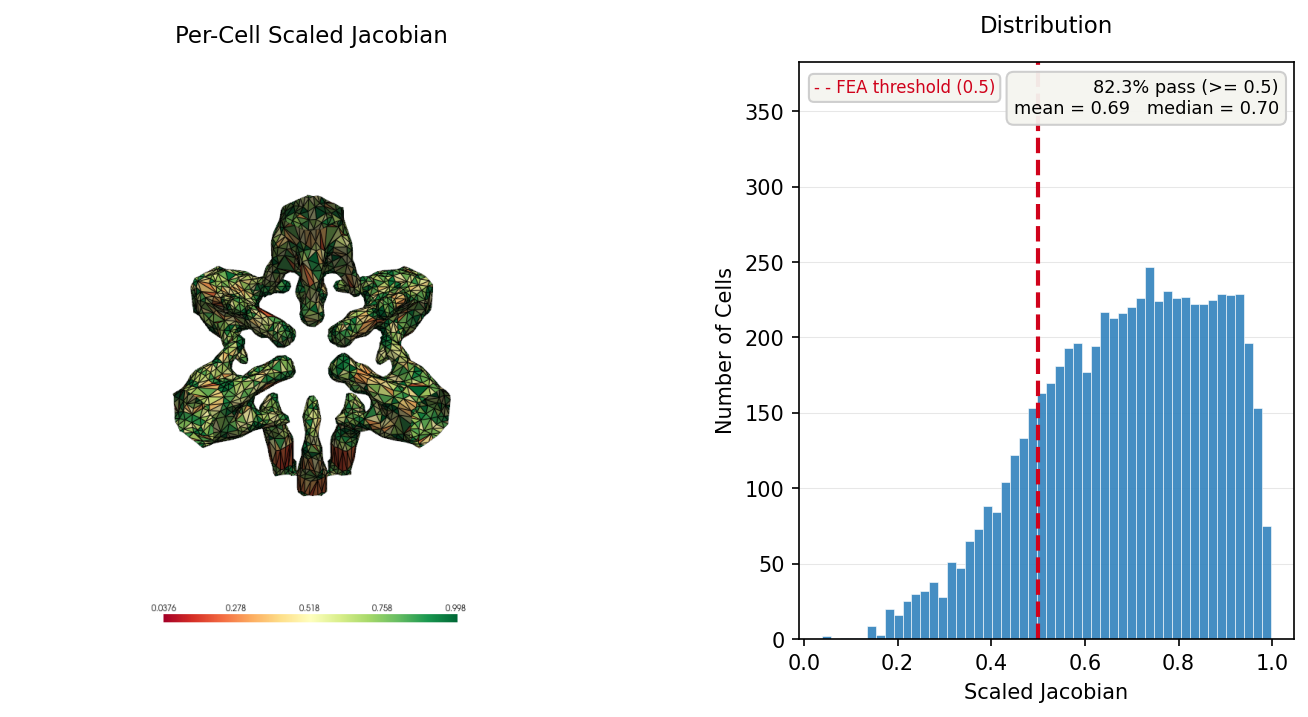
Elements that violate these thresholds can cause numerical instability, poor conditioning, or inaccurate stress/strain results in FEA solvers.
How metrics are computed
Quality metrics are computed using PyVista, which wraps VTK's mesh quality filters. The benchmark script converts the pipeline output to a PyVista PolyData mesh and calls cell_quality() with three measures:
import numpy as np
import pyvista as pv

# Build PyVista mesh from pipeline state
faces_pv = np.column_stack([np.full(len(state.faces), 3), state.faces]).ravel()
pv_mesh = pv.PolyData(state.best_vertices.astype(np.float64), faces_pv)

# Compute quality metrics
qual = pv_mesh.cell_quality(["aspect_ratio", "min_angle", "scaled_jacobian"])

# Access per-cell values
aspect_ratios = qual.cell_data["aspect_ratio"]
min_angles = qual.cell_data["min_angle"]
jacobians = qual.cell_data["scaled_jacobian"]
Each metric produces a per-cell (per-triangle) array. The benchmark reports the minimum, mean, maximum, and standard deviation.
Additional properties checked by the benchmark:
- Watertight -- Whether the mesh forms a closed manifold (checked via
trimesh.Trimesh.is_watertight) - Volume -- Computed by trimesh for watertight meshes only
- Surface area -- Total mesh surface area
Current baseline results
These results were captured with the default pipeline parameters using the benchmark script. They represent the baseline quality before any Tier 2 improvements (decimation, remeshing).
3D models
| Model | Vertices | Faces | Watertight | AR (mean) | Angle (min) | Jacobian (min) | Time (s) |
|---|---|---|---|---|---|---|---|
| heat_cond_51_s0 | 7,087 | 13,910 | no | 1.27 | 3.2 deg | 0.064 | 0.011 |
| heat_cond_51_s1 | 17,287 | 33,528 | no | 1.26 | 3.2 deg | 0.064 | 0.015 |
| thermoelastic_16_s0 | 979 | 1,806 | no | 1.39 | 0.8 deg | 0.016 | 0.002 |
| corner_3d_vf50_s0 | 2,123 | 3,902 | no | 1.38 | 2.8 deg | 0.056 | 0.003 |
| corner_3d_vf30_s0 | 1,961 | 3,568 | no | 1.42 | 0.5 deg | 0.010 | 0.003 |
| synthetic_sphere | 192 | 380 | yes | 1.20 | 30.4 deg | 0.584 | 0.002 |
| synthetic_sphere_sdf | 984 | 1,964 | yes | 1.31 | 24.2 deg | 0.473 | 0.001 |
2D models
| Model | Contours | Total Points | Volume Fraction | Time (s) |
|---|---|---|---|---|
| beam_2d_100x200_s0 | 5 | 356 | 0.2375 | 0.001 |
Observations
- Mean aspect ratios are good (all below 1.5), well within the < 5 target
- Minimum angles are below the 20-degree target for most real-world TO models. The synthetic sphere meets the target, but TO geometry with thin features and sharp corners produces degenerate triangles
- Minimum scaled Jacobians are below the 0.5 target for all TO models. Again, synthetic geometry is much closer to the target
- No TO model produces a watertight mesh with the current pipeline. Watertight output will require dedicated repair/remeshing stages
- These limitations are expected for marching cubes output without decimation or remeshing and represent the improvement targets for future pipeline stages
Running the benchmark
The benchmark script processes all registered models (EngiBench datasets, Corner-Based TO, and synthetic shapes) and generates meshes, comparison plots, 3D renders, and a metrics summary.
uv run python scripts/benchmark_baseline.pyOutput goes to benchmarks/baseline/ by default. Specify a different directory to compare before/after:
uv run python scripts/benchmark_baseline.py --output-dir benchmarks/after-remeshingThe script generates:
| File | Description |
|---|---|
<model>.stl | Exported mesh for each 3D model |
<model>_comparison.png | Side-by-side scalar field vs extraction result |
<model>_mesh.png | 3D mesh render (requires PyVista) |
metrics.json | Full metrics for all models (JSON) |
summary.md | Human-readable summary table |
PyVista is required for quality metrics (aspect_ratio, min_angle, scaled_jacobian) and 3D renders. The benchmark still runs without it but skips those outputs.